



Discharge from the sexual organs in men is discharge from the urethra (urethra) and the secretion of the foreskin glands, which are located on the glans under the skin of the foreskin.The ejaculatory duct, the ducts of the prostate, the urethra and the bulbourethral glands open into the urethra.
In a healthy man, only urine and ejaculate flow through the urethra.These are physiological secretions from the penis that should not cause any discomfort.Unfortunately, this is not always the case.
For various reasons, the man's health is weakened and instead of normal discharge, there is abnormal discharge or changes in urine and sperm
Variants of physiological secretions
Criteria for normal discharge according to the functions of the organs of the urogenital system:
- The urine is clear, straw to golden yellow in color, practically odorless and contains no flakes or other inclusions;
- The prostatic secretion has a viscous consistency and a whitish color and it smells specifically of sperm;
- Ejaculate: Semen from the ejaculatory duct mixes with secretions of the urethral gland (urethra), Cooper's gland (bulbourethral) and prostatic secretion and acquires a gray-white color and a mucous consistency;
- Fresh smegma from the foreskin glands looks like a thick white lubricant;may become yellowish or greenish over time.
Preputial lubricant - smegma - is constantly secreted and accumulates under the inner layer of the foreskin and in the coronal groove of the penis.The lubricant consists of fats and bacterial residues, is evenly distributed and reduces friction between the skin of the foreskin and the glans.The maximum activity of the foreskin glands is characteristic of puberty;With increasing age, secretion decreases and stops altogether in old age.
If you neglect the rules of personal hygiene, smegma can accumulate under the folds of the foreskin.In this case, the fat portion of the lubricant oxidizes, and the protein portion breaks down (in fact, rots), and the masses become greenish and acquire an unpleasant odor.The same process occurs with phimosis, when, due to the fusion of the foreskin, it is impossible to completely free the head of the penis from the skin folds and remove the smegma.The accumulation and breakdown of lubricant can lead to chronic balanitis and balanoposthitis (inflammation of the foreskin and glans) and increase the risk of tumor development.
Urethrorrhea, mucous, colorless discharge from the bulbourethral and urethral glands.These discharges occur in men during arousal related to libido.The excretion of clear mucus is intended to moisten the urethra and improve sperm passage.The amount of secretion ranges from sparse to abundant;These parameters are related to the individual characteristics of the body and the frequency of sexual activity.After a long period of abstinence, the amount of discharge increases.
A wet dream is a spontaneous release of sperm that is not associated with sexual intercourse.Usually seen in the morning when testosterone levels rise.Depends on the age and intensity of sexual activity: it occurs in boys during puberty, in adult men – with irregular or infrequent sexual intercourse.
Prostatorrhea, discharge from the urethra of a small amount of transparent mucus with grayish-white inclusions.Occurs after overexertion of the abdominal muscles (for example when constipated) or after urination.The secretion consists of a mixture of semen and prostate secretion;Increased volume and cloudiness can be signs of prostatitis.
Pathological discharge
In men, the causes of discharge from the penis can be sexually transmitted diseases, tumors, nonspecific inflammation of the urogenital organs, various injuries, medical procedures or operations.
Pathological discharge from the urethra differs from the normal state:
- By volume (too abundant or sparse, perhaps moderate);
- By color and transparency (from white to yellow-green, cloudy);
- Through impurities (blood, pus, clots of mucus);
- consistency (very runny or too thick and sticky);
- By smell (sour, putrid, fishy);
- Depending on the frequency of occurrence (constant or episodic discharge depending on the time of day);
- Associated with urination, sexual arousal, alcohol consumption, hot and spicy foods.
The type of discharge depends on the causative agent of the disease, the status of the immune system, concomitant diseases, as well as the severity and duration of the inflammation (acute or chronic).
If there is a change in the amount, density or color of the discharge or if an unpleasant smell occurs, it is advisable to see a doctor and have tests carried out.There is no point in self-diagnosis;It is very difficult to correctly identify the disease based on just one symptom.
Penile discharge associated with sexually transmitted diseases
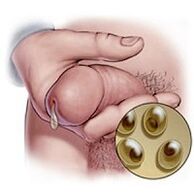
Mucous: transparent discharge, viscous and in small quantities, occurs in the chronic form of chlamydial, mycoplasma or ureaplasma urethritis.Microscopy shows a moderate number of leukocytes in the discharge (up to 4 cells in the field of view are normal).
Mucopurulent: white discharge, translucent;observed in the acute phase of chlamydia, ureaplasmosis and mycoplasmosis.During a chlamydia infection, they accumulate on the glans as if they were “sticking” to the skin.
In the pathologies described above, the discharge comes from the urethra itself, since microorganisms irritate the mucous membrane of the urethra and the body tries to “flush” them away.
It happens that a white secretion seems to cover the head.This is seen with chlamydia and candidiasis.In the first case a film forms, in the second case a loose, cheesy coating forms.
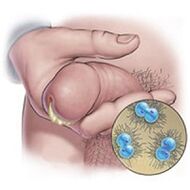
Gonorrhea is characterized by purulent discharge with an unpleasant odor.They are sticky, thick, yellow or greenish and have a foul smell.Under the microscope, epithelial cells from the urethra and many leukocytes are visible in the material.
Accompanying symptoms of gonorrheic urethritis: constant and profuse discharge;Pain, itching and burning are particularly severe when urinating.
Combined infections are often observed in sexually transmitted diseases, in which several pathogens occur at the same time.Gonorrhea and trichomoniasis are accompanied by chlamydia;Mycoplasmosis and ureaplasmosis usually occur in pairs.The symptoms of such diseases differ from the classic manifestations;Urethral discharge can also take on a completely different character.Modern analytical techniques with high reliability are therefore used for the final diagnosis and not the properties of the secretions.
Non-specific (non-venereal) inflammation
The cause of non-specific inflammation is the body's own microflora, which is classified as opportunistic and is only activated when there are problems with the body's immune system.Streptococci and staphylococci, fungi of the genera Candida and E. coli, are always present on the surface of the skin and mucous membranes, but begin to actively multiply and displace beneficial bacteria after hypothermia, prolonged stress, uncontrolled treatment with antibiotics, after courses of radiation and chemotherapy.
Nongonorrheic (nonspecific) urethritis.The inflammatory discharge is small in volume, visible in the urine as mucopurulent strands or lumps, and occurs at the very onset of the disease.The symptoms of burning and itching during urination are less pronounced than those of gonorrhea, but the urge is frequent and does not bring relief.In an ascending infection, the bladder first becomes inflamed, then the ureters and kidneys;A discharge mixed with scarlet blood appears.
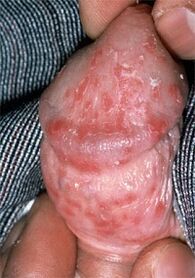
Candidiasis (thrush), fungal infection of the urethra.Usually develops against the background of suppression of the immune system after antibiotic, chemotherapy or radiation therapy;Sexual transmission of candidiasis in men is rare.Thrush is characterized by a curd-like discharge with a sour smell, which is accompanied by itching and burning when urinating and ejaculating and can be accompanied by dull pain in the groin, over the pubic bone and in the lower back.
Gardnerellosis of the urethra.The discharge has a fishy smell;they are sparse, yellowish-white or greenish.According to some classifications, gardnerella is classified as a sexually transmitted disease, but in men, infection with gardnerella through sexual contact is more of a curiosity.In fact, this disease is associated with a disruption of the normal microflora, that is, dysbacteriosis.During treatment, immune correctors and probiotics (lactic acid bacteria) are necessarily used.
Balanoposthitis, inflammation of the foreskin.Abundant purulent discharge is observed locally, and there may be an admixture of mucus.They are always accompanied by swelling and hyperemia (redness) of the leaves of the foreskin and pain in the head of the penis.
With prostatitis, cloudy discharge appears at the end of urination, abundant discharge – during the acute inflammatory phase;sparse and white - if the disease becomes chronic.Prostatitis is usually complicated by difficulty urinating and weak erections, in severe cases even leading to anuria (complete failure to excrete urine) and impotence.
Discharge that is not associated with inflammation

Spermatorrhea is a discharge in the form of passively flowing sperm that occurs outside of sexual intercourse or masturbation, without the feeling of orgasm.The reasons are some diseases of the nervous system, spinal injuries, chronic stress and possible long-term inflammation of the genital area.Spermatorea is associated with impaired innervation and reduced tone of the vas deferens.
Hematorrhea, bloody discharge.Often occurs in injuries to the urethral canal that occur during bougienage, after insertion of a catheter or when taking a swab of the mucous membrane.In these cases, the blood is fresh, without clots, the amount is small, and the bleeding stops quickly.If small kidney stones or sand come out and blood is released during or immediately after urination, hematorrhea is accompanied by very severe pain (renal colic).Blood discharge in the hematuric form of glomerulonephritis (inflammation of the kidney glomeruli) is accompanied by edema and persistently increased blood pressure, as well as the appearance of protein in the urine.
Brown discharge with clumps of blood or mucus mixed with pus occurs with malignant tumors arising from the prostate, urethra, or bladder.When wounds heal on the mucous membranes, brownish mucus can form, which is released in polyposis of the urethra and/or bladder.
Prostatorrhea is the secretion of the prostate gland flowing from the urethra.Occurs in chronic prostatitis, prostate adenoma and impaired innervation (neurogenic bladder).
Examination algorithm for the presence of pathological discharge from the penis

- Inspection of the perineum, penis, foreskin and glans.The aim is to detect deformities of the genital organs, traces of injury, signs of external inflammation, discharge, rash, etc.Traces of discharge can sometimes be seen on the underwear.
- Palpation of the inguinal lymph nodes, assessment of their condition: size, whether they are warmer or colder than the surrounding tissues, painful or not, soft or hard, mobile or adherent to the skin, whether there are ulcers above them.
- Digital examination of the prostate;Massage the prostate through the rectum and collect secretions for microscopic examination.Before the massage, it is recommended to avoid urinating for 1-2 hours.In prostate adenoma, its lobes are approximately equally enlarged, dense strands are palpable.Uneven growths and their consistency are typical of a malignant tumor;When the prostate is palpated, blood with blood clots may be released from the urethra.
- Material: Swabs for microscopy and culture.When examined under a microscope, the stained smear reveals blood cells, epithelium, sperm, fatty inclusions and some pathogens (Escherichia coli, gonococci, gardnerella, yeast).An increased number of leukocytes is characteristic of acute urethritis or exacerbation of chronic inflammation, eosinophils – of urethritis due to allergies.Red blood cells are detected in severe inflammation, tumors, injuries to the urogenital organs and urolithiasis.A large amount of epithelium is a sign of chronic urethritis, urethral leukoplakia.With spermatorrhea, sperm are found in the smear, with urethrorrhea - mucus, prostatorrhea - lipid granules.To ensure the significance and reliability of the results, the swab is taken at the earliest 3 days after the local application of antibiotics, antimycotics and disinfectants.If the treatment with antibiotics was systemic, at least 3 weeks should elapse after the course.Do not wash before the swab;Try not to urinate for 2-3 hours.
- General clinical blood test, blood sugar test – in the morning on an empty stomach.Detailed urine analysis (morning portion, immediately after sleep).
- Ultrasound of the prostate, bladder and kidneys;CT and urography.
If the manifestations of genital inflammation are severe, the patient is immediately prescribed broad-spectrum antibiotics before receiving the test results.If bleeding is severe, hospitalization and active measures to stop bleeding are indicated.Suspicion of a malignant tumor can only be confirmed by the results of a biopsy;The final diagnosis is made on the basis of histological examination.
Important:
- Penile discharge is just a symptom and cannot be used as a guide to diagnosis.
- Independent prescription of medicines is unacceptable.Medication, even if the manifestations for a particular disease seem obvious.